The snow falls courtesy of Currier & Ives at the Springfield Symphony Hall in Massachusetts this weekend! The orchestra is performing a Holiday Pops concert and it's using a fabulous selection of Currier & Ives lithographs as a giant slide show behind the performers. It's all part of the educational collaboration surrounding the Museum's Currier & Ives collection and WGBY's series about the "Printmakers to the American People". Concertgoers will be treated to a dramatic show of the prints so often associated with Christmas cards and cookie tins, images like "Winter in the Country-A Cold Morning" from the painting by New Haven artist George Durrie. We've had weirdly warm weather lately...but inside Symphony Hall, it'll be winter!
Editing begins on Episode 1 next week and so all video, digitized images (so many!), music and more are being loaded onto the computer. NPR's Scott Simon will be recording his narration on December 17 and so we will begin the edit without his voice. Putting it on during the last week of the edit will be like adding the magic!
The air date has been changed to Monday, February 25 at 9pm. All 3 episodes will air back-to-back, although they may be repeated in separate installments.
I just got word that there may be a Berkshires premiere at Hancock Shaker Village on January 11, which thrills me. I lived in the Berkshires for nearly 4 years and love the area's appreciation for the arts and for the work of local artists and producers like WGBY.
Episodes 2 & 3 are being polished and I'm preparing a detailed narrative report so that the grantmakers can see what we've been up to. Busy week! I'll keep you posted.
Tuesday, November 27, 2007


Tuesday, November 13, 2007
Marketing the Marketers
The holiday season grabs us from behind, doesn't it? One minute you're handing out candy to mini-goblins and the next you're behind in your Christmas shopping! For Currier & Ives: Perspectives on America, the holiday season is key. Most people associate the work of Currier & Ives with the holidays because the publishing firm's cozy winter images have been used so often on holiday cards and other products. For programming reasons, the series doesn't air until later in the winter, but we will be using the festive season to make folks aware of the good things coming. That means promotion, promotion, promotion! A plan is in the works and it's central to the whole project schedule right now. And so we find ourselves in the position of marketing the Kings of Marketing, Mr. Currier & Mr. Ives. I'm pretty certain they might have chosen a more sensational path than the one PBS will take!
For me, that means several speaking engagements and showing the short video you can watch on our website. It also means a really exciting premiere of Part 1 of the 3-part series at the Academy of Music in Northampton in mid-January.
One of the collaborations I love best is between the Springfield Symphony, the Springfield Museums and WGBY. All of us are coming together during the first weekend in December for a "Currier & Ives Holiday Pops" concert! We had a meeting recently that served as one of those reminders of why I love what I do. It was just pure creative fun to think about the music and what prints might fit best as a backdrop and then to just throw around ideas about how to give it a festive, 19th century feel. Don't be surprised if you see a sleigh in front of Symphony Hall in Springfield, Massachusetts that weekend!
On the production front, scriptwriting continues and we've had a couple of really interesting shoots. I wanted to get a feel for whether children today make any connection with these supposedly timeless images. We went to the Springfield Museum of Fine Arts to catch up with some 5th graders touring the permanent Currier & Ives Gallery there. I will admit that I was astounded by how interested these kids were in the pictures! Granted, some of it may have been playing to the camera...but that does not account for all of the enthusiasm and interest we witnessed. I asked the kids (who are largely minority, urban, lower income) if the people in the prints look like them and they were very firm in their answer: "No!". But they went on to tell me that these could be their ancestors and that's why it was important to look at the pictures and try to figure out what the heck is going on in them. Now, they probably know those white, Protestant, 19th century folks are not blood kin...but I got the sense that the children were identifying on a different level with the figures in the lithographs, identifying with place and therefore, experience. Fascinating morning.
Yesterday, I told that story to the couple to whom it matters most: Sid and Lennee Alpert. Sidney and Lenore Alpert are the collectors who gifted about 800 Currier & Ives prints and related items to the Springfield Museums - and inspired this entire educational effort. Now, they could've made much, much, much more money by selling the items but they wanted everyone to have the chance to see them for as long as possible. They chose Springfield because the Museums made the promise of a permanent gallery (no filing the prints away in drawers!), they liked the people there and they loved the idea of Currier's work coming to his home state of Massachusetts. The Alperts made the trip up from Maryland to let me get some shots of Sid with his collection and to talk to both of them. We talked to Sid in his home office over the summer but I have to say, he seemed a lot more relaxed among his beloved Currier & Ives collection! This terrific couple have been together so long they finish AND start each other's sentences! They're a joy to be around and the pride they feel in the collection is palpable. Lennee said she didn't want to talk on camera but looking at the old prints got her to reminiscing and the next thing you know, we had a spontaneous interview! She also revealed a lot of fun secrets behind Sid's collecting 'habit'.
Finally, it looks like the air dates will be February 3 & 24, 2008...but that's not set in stone.
I'm looking forward to two presentations on the documentary series this weekend, including one at our third Teacher Workshop.
I'll keep you posted.
For me, that means several speaking engagements and showing the short video you can watch on our website. It also means a really exciting premiere of Part 1 of the 3-part series at the Academy of Music in Northampton in mid-January.
One of the collaborations I love best is between the Springfield Symphony, the Springfield Museums and WGBY. All of us are coming together during the first weekend in December for a "Currier & Ives Holiday Pops" concert! We had a meeting recently that served as one of those reminders of why I love what I do. It was just pure creative fun to think about the music and what prints might fit best as a backdrop and then to just throw around ideas about how to give it a festive, 19th century feel. Don't be surprised if you see a sleigh in front of Symphony Hall in Springfield, Massachusetts that weekend!
On the production front, scriptwriting continues and we've had a couple of really interesting shoots. I wanted to get a feel for whether children today make any connection with these supposedly timeless images. We went to the Springfield Museum of Fine Arts to catch up with some 5th graders touring the permanent Currier & Ives Gallery there. I will admit that I was astounded by how interested these kids were in the pictures! Granted, some of it may have been playing to the camera...but that does not account for all of the enthusiasm and interest we witnessed. I asked the kids (who are largely minority, urban, lower income) if the people in the prints look like them and they were very firm in their answer: "No!". But they went on to tell me that these could be their ancestors and that's why it was important to look at the pictures and try to figure out what the heck is going on in them. Now, they probably know those white, Protestant, 19th century folks are not blood kin...but I got the sense that the children were identifying on a different level with the figures in the lithographs, identifying with place and therefore, experience. Fascinating morning.
Yesterday, I told that story to the couple to whom it matters most: Sid and Lennee Alpert. Sidney and Lenore Alpert are the collectors who gifted about 800 Currier & Ives prints and related items to the Springfield Museums - and inspired this entire educational effort. Now, they could've made much, much, much more money by selling the items but they wanted everyone to have the chance to see them for as long as possible. They chose Springfield because the Museums made the promise of a permanent gallery (no filing the prints away in drawers!), they liked the people there and they loved the idea of Currier's work coming to his home state of Massachusetts. The Alperts made the trip up from Maryland to let me get some shots of Sid with his collection and to talk to both of them. We talked to Sid in his home office over the summer but I have to say, he seemed a lot more relaxed among his beloved Currier & Ives collection! This terrific couple have been together so long they finish AND start each other's sentences! They're a joy to be around and the pride they feel in the collection is palpable. Lennee said she didn't want to talk on camera but looking at the old prints got her to reminiscing and the next thing you know, we had a spontaneous interview! She also revealed a lot of fun secrets behind Sid's collecting 'habit'.
Finally, it looks like the air dates will be February 3 & 24, 2008...but that's not set in stone.
I'm looking forward to two presentations on the documentary series this weekend, including one at our third Teacher Workshop.
I'll keep you posted.
Monday, October 29, 2007
1837, Revisited
The crew loved time travel so much, we decided to do it again!
It was back to Old Sturbridge Village for an Autumn shoot last week. We had hoped to get shots that echo scenes from beautiful Currier & Ives autumn prints, but alas, Mother Nature was uncooperative on a couple of fronts. First, it rained for more than half the day. Secondly, there just wasn't much foliage to shoot! They say we missed this year's pitiful peak by a few days. Still, we have some beautiful footage of indoor handwork, such as blacksmithing. The fire, the hammering, the smoke, the red-hot iron, the bellows: a cameraperson's dream! The village cooper also provided us with wonderful video and audio opportunities and we got the inside scoop on how to make a "Piggin". We didn't know what it was, either. It turns out that it's a wooden bucket used to collect scraps to toss out to the pigs.
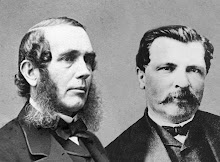
We'll shoot at the Village two more times. Up next, a few re-enactments to be shot there later in the Fall. The folks at Old Sturbridge are conducting an informal scout for Currier & Ives lookalikes, or at least, built-alikes. We'll tape two men representing the printmakers at work together, poring over prints, and walking together, etc. It will likely be done in shadow or silhouette. I don't need actors who exactly resemble Nathaniel Currier and James Ives, but I do need them to have similar builds. That means one is slim, tall, and fair and the other is dark, short, stocky and probably younger.
In the winter at the Village, we will try recreating Currier & Ives famous "The Road-Winter" sleighride, which is arguably the firm's single most recognizable image. Of course, we'll also use Old Sturbridge Village as a backdrop for scenes reminiscent of the firm's most famous (and now, valuable) large folio winter lithographs drawn from paintings by New Haven artist, George Durrie. Let's hope Mother Nature makes up for an anemic Fall with some hearty Winter snowstorms!
On another front, we're preparing for two more Teacher Workshops at the Springfield Museums that will use its Sid and Lenore Alpert Collection of Currier & Ives prints as a springboard for developing innovative lesson plans. I'll be presenting the short video, which you can link to on the website, at November 17th's Workshop.
On November 12, Sid Alpert himself will come to Springfield for some additional shooting. You may remember that we shot an interview with Sid at his home in Maryland over the Summer. I wanted him here in Springfield to see him with his former collection and to add visual support to the story of his prints "coming home" to Massachusetts.
I apologize that this blog is a week late; I recently lost a round with the flu and I'm getting back on my feet and catching up on things!
I'll keep you posted.
It was back to Old Sturbridge Village for an Autumn shoot last week. We had hoped to get shots that echo scenes from beautiful Currier & Ives autumn prints, but alas, Mother Nature was uncooperative on a couple of fronts. First, it rained for more than half the day. Secondly, there just wasn't much foliage to shoot! They say we missed this year's pitiful peak by a few days. Still, we have some beautiful footage of indoor handwork, such as blacksmithing. The fire, the hammering, the smoke, the red-hot iron, the bellows: a cameraperson's dream! The village cooper also provided us with wonderful video and audio opportunities and we got the inside scoop on how to make a "Piggin". We didn't know what it was, either. It turns out that it's a wooden bucket used to collect scraps to toss out to the pigs.
We'll shoot at the Village two more times. Up next, a few re-enactments to be shot there later in the Fall. The folks at Old Sturbridge are conducting an informal scout for Currier & Ives lookalikes, or at least, built-alikes. We'll tape two men representing the printmakers at work together, poring over prints, and walking together, etc. It will likely be done in shadow or silhouette. I don't need actors who exactly resemble Nathaniel Currier and James Ives, but I do need them to have similar builds. That means one is slim, tall, and fair and the other is dark, short, stocky and probably younger.
In the winter at the Village, we will try recreating Currier & Ives famous "The Road-Winter" sleighride, which is arguably the firm's single most recognizable image. Of course, we'll also use Old Sturbridge Village as a backdrop for scenes reminiscent of the firm's most famous (and now, valuable) large folio winter lithographs drawn from paintings by New Haven artist, George Durrie. Let's hope Mother Nature makes up for an anemic Fall with some hearty Winter snowstorms!
On another front, we're preparing for two more Teacher Workshops at the Springfield Museums that will use its Sid and Lenore Alpert Collection of Currier & Ives prints as a springboard for developing innovative lesson plans. I'll be presenting the short video, which you can link to on the website, at November 17th's Workshop.
On November 12, Sid Alpert himself will come to Springfield for some additional shooting. You may remember that we shot an interview with Sid at his home in Maryland over the Summer. I wanted him here in Springfield to see him with his former collection and to add visual support to the story of his prints "coming home" to Massachusetts.
I apologize that this blog is a week late; I recently lost a round with the flu and I'm getting back on my feet and catching up on things!
I'll keep you posted.
Monday, October 8, 2007
Currier & Surprise
What makes a good documentary is surprising. The verb surprising, not the adjective. There is something so satisfying about sharing an astounding insight, revealing new information, or providing the lens that allows someone to see a familiar thing with fresh eyes.
When you're researching a subject that has been well covered over the course of more than a century, sources often re-tell similar stories and cite familiar facts. But once in a while, you hear something that snaps you to attention. That's why talking with Chris Lane last week was so much fun. Lane is the co-owner of The Philadelphia Print Shop and a regular contributor to PBS' Antiques Road Show.
In our interview at WGBY's studio, Chris revealed that he doesn't buy the oft-told tale that the Lexington disaster print launched Nathaniel Currier's career. He demands the statistics that back that up. He's lively on this topic and so many others because he just never accepts the conventional wisdom about Currier & Ives. His is an historian's mind, always digging deeper and challenging the easy answers. I know you'll enjoy his presence throughout the series because he combines elevated knowledge with a down-to-earth delivery.
The crew later drove to pretty Deerfield, Massachusetts to catch Chris Lane at work at an astounding Antiques Fair. Here, he showed me something I'd never noticed before: a print in which some of the faces appear to be photographically copied onto bodies. Chris is sure they are photographic images and not drawn and indeed, they do look different than other faces in the lithograph. There are other Currier & Ives pictures in which he says the same technique was used. After a little more research, I think we will look at some of those prints in the series and explore why the technique may have been used. This information was a fascinating surprise.
This week, I'll be setting up some Fall shoots at Old Sturbridge Village and the Springfield Museums and, of course, the writing continues. I'll keep you posted.
When you're researching a subject that has been well covered over the course of more than a century, sources often re-tell similar stories and cite familiar facts. But once in a while, you hear something that snaps you to attention. That's why talking with Chris Lane last week was so much fun. Lane is the co-owner of The Philadelphia Print Shop and a regular contributor to PBS' Antiques Road Show.
In our interview at WGBY's studio, Chris revealed that he doesn't buy the oft-told tale that the Lexington disaster print launched Nathaniel Currier's career. He demands the statistics that back that up. He's lively on this topic and so many others because he just never accepts the conventional wisdom about Currier & Ives. His is an historian's mind, always digging deeper and challenging the easy answers. I know you'll enjoy his presence throughout the series because he combines elevated knowledge with a down-to-earth delivery.
The crew later drove to pretty Deerfield, Massachusetts to catch Chris Lane at work at an astounding Antiques Fair. Here, he showed me something I'd never noticed before: a print in which some of the faces appear to be photographically copied onto bodies. Chris is sure they are photographic images and not drawn and indeed, they do look different than other faces in the lithograph. There are other Currier & Ives pictures in which he says the same technique was used. After a little more research, I think we will look at some of those prints in the series and explore why the technique may have been used. This information was a fascinating surprise.
This week, I'll be setting up some Fall shoots at Old Sturbridge Village and the Springfield Museums and, of course, the writing continues. I'll keep you posted.
Wednesday, September 26, 2007
Time to launch
After months of preparation, it's time to launch the documentary series! By that, I mean it's time to start writing the three half-hour episodes to be aired on PBS. With this much material, where to begin? That's my challenge. Fortunately, I created an outline of the three parts months ago and despite all that I've learned since then about Currier & Ives and 19th century America, it remains a good framework and a touchstone to which I will return time and time again.
Part 1 is called "Printmakers to the People" and will focus on the early years, turning points for the firm and personal insights into Currier & Ives.
Part 2 is titled "Cheap & Popular Pictures" and it will feature some of the most and least popular of the firm's output, as well as a closer look at the artists behind the firm and the passion of collectors today.
Part 3 is "The Surprise of Currier & Ives" and will give us the chance to examine the controversial and/or unusual lithographs that the firm produced throughout its long history.
Along the way, we'll see how the pictures made by Currier & Ives compare to what was really going on in the country, we'll contemplate whether the firm's prints reflected or projected an emerging American identity, if they can stand the test of time, and how these approximately 8,000 pictures launched the mass media that inundates us with thousands of images every day.
We do have a few shoots left, including an interview in WGBY's studios with Chris Lane of the Philadelphia Print Shop. You may recognize Chris from PBS' "Antiques Road Show". He, along with Robert Newman, is known as a top Currier & Ives expert and although the two men are competitors in the business world, they have graciously agreed to share the spotlight and spread the wealth of information for these documentaries. They've also been very generous in sharing rare images and records. We'll talk to Chris next week and later, catch him in action at the Historic Deerfield Antiques Show.
The first panel of animation for the series open is finished and it is just magical. Our appreciation to the talented folks at iMarc, who have shown so much enthusiasm for this job! They will also animate "The Awful Conflagration of the Steam Boat Lexington" and "Winter in the Country - A Cold Morning" for the open. The animators are most excited about "Lexington", with all its fire, smoke, and action. "Winter in the Morning" provides more subtle animation opportunities, such as snow falling, the man and dog walking, and smoke curling from the chimney.
I'm listening to online recordings of our narrator's voice to get it solidly in my ear and in my mind - in other words, to make sure that I capture that special Scott Simon quality while writing the narration for the series. I call it writing to voice. It's important in terms of both time and effort because it means that in the end, your narrator doesn't re-write your script so that he or she can read more comfortably and naturally.
That's it for now. Check the website over the next couple of weeks if you'd like information about our Teacher Workshop coming up in November, 2007.
Part 1 is called "Printmakers to the People" and will focus on the early years, turning points for the firm and personal insights into Currier & Ives.
Part 2 is titled "Cheap & Popular Pictures" and it will feature some of the most and least popular of the firm's output, as well as a closer look at the artists behind the firm and the passion of collectors today.
Part 3 is "The Surprise of Currier & Ives" and will give us the chance to examine the controversial and/or unusual lithographs that the firm produced throughout its long history.
Along the way, we'll see how the pictures made by Currier & Ives compare to what was really going on in the country, we'll contemplate whether the firm's prints reflected or projected an emerging American identity, if they can stand the test of time, and how these approximately 8,000 pictures launched the mass media that inundates us with thousands of images every day.
We do have a few shoots left, including an interview in WGBY's studios with Chris Lane of the Philadelphia Print Shop. You may recognize Chris from PBS' "Antiques Road Show". He, along with Robert Newman, is known as a top Currier & Ives expert and although the two men are competitors in the business world, they have graciously agreed to share the spotlight and spread the wealth of information for these documentaries. They've also been very generous in sharing rare images and records. We'll talk to Chris next week and later, catch him in action at the Historic Deerfield Antiques Show.
The first panel of animation for the series open is finished and it is just magical. Our appreciation to the talented folks at iMarc, who have shown so much enthusiasm for this job! They will also animate "The Awful Conflagration of the Steam Boat Lexington" and "Winter in the Country - A Cold Morning" for the open. The animators are most excited about "Lexington", with all its fire, smoke, and action. "Winter in the Morning" provides more subtle animation opportunities, such as snow falling, the man and dog walking, and smoke curling from the chimney.
I'm listening to online recordings of our narrator's voice to get it solidly in my ear and in my mind - in other words, to make sure that I capture that special Scott Simon quality while writing the narration for the series. I call it writing to voice. It's important in terms of both time and effort because it means that in the end, your narrator doesn't re-write your script so that he or she can read more comfortably and naturally.
That's it for now. Check the website over the next couple of weeks if you'd like information about our Teacher Workshop coming up in November, 2007.
Friday, September 7, 2007
Broaden the Impact, Deepen the Understanding
Sometimes it is tough for teachers to take on more. Many, especially in poorer cities, are pushed to their professional limits to meet the demands of the federal government, the state, parents, students and a host of others with opinions on how they might do their jobs better. I want to begin this blog by thanking the 35 Springfield teachers who enthusiastically "took on more" in our Currier & Ives Teacher Workshop at the Springfield Museum of Fine Art. In the end, we hope that by broadening the impact of the Currier and Ives collection at the Springfield Museums, we may ease teachers' workloads and deepen students' understanding of real American history.
"The Dark Side of Currier & Ives: Teacher Workshop" examined how the ideals of American democracy portrayed in Currier & Ives prints actually played out for those outside mainstream 19th century America: African Americans, Native Americans, women, and immigrants. This is an important discussion for teachers who are trying to convey the relevance of the collection to largely minority students! How can these children relate to these pictures and why should they care? What in the world do these scenes have to do with them, anyway?
Lecturers Dan Czitrom from Mount Holyoke College and James Smethurst of UMass provided context for the works and gave two views on the controversial topic of the Darktown Comic Series.
Teachers examined the works for themselves and learned about how they were made. They also enjoyed a behind-the-scenes look at how the curatorial staff preserves the prints.
In addition, teachers were introduced to Visual Thinking Strategies, a simple approach to analyzing images and a way to generate discussion with students using the prints as source material. VTL asks 3 simple questions: 1) What is going on in this picture? 2) What do you see that makes you say that? 3)What more can you find?
Patricia Johnson of Salem State College showed teachers how to explore ways that prints or other primary source materials can be used in the classroom as teaching tools.
Finally, I made a presentation of WGBY's short video previewing the upcoming documentaries and talked about some of what I've learned about the firm along the way. The biggest response during the video was a collective gasp when a collector revealed that someone recently paid $76,000 for a Currier & Ives print called "The American National Game of Baseball"!
I have read the teacher reviews of the workshop and they are glowing. The only consistent complaint was that the chairs were horribly uncomfortable. We look forward to another workshop in November and perhaps by then we'll have better chairs!
On the production front, the company iMarc presented a storyboard of its first animation for our series open and it looks great. They're animating "The Road-Winter" and when I found out they planned on making the horses move across the screen, I realized the animators needed to know that they are most likely trotters, which have a particular gait. Gail Cunard of the Harness Racing Museum and Hall of Fame quickly provided iMarc with slow-motion video of a trotting champion so that they can duplicate his movements in the animation. Fascinating stuff!
The crew shot this week at the Brimfield Antique Show. We captured the passion of the Currier & Ives collector by following John Zak on his treasure hunt. Zak is probably the premier Currier & Ives collector in the country, with a collection of thousands of prints that I have seen personally. It's amazing! What's more amazing is how fast one man on a mission can move through crowded fields of antiques. We had trouble keeping up! John didn't find the special large folio he'd hoped to find but he did manage to add 7 smaller prints to his collection. Most importantly, our audience will learn so much just by listening to his dialogue with the dealers about condition, margins, impression quality, and rarity. The man is an expert and a wonderful human being, to boot. He has been extraordinarily generous with his time and expertise throughout this project. Thanks, JohnZak!
That's all for now; I'll keep you posted.
"The Dark Side of Currier & Ives: Teacher Workshop" examined how the ideals of American democracy portrayed in Currier & Ives prints actually played out for those outside mainstream 19th century America: African Americans, Native Americans, women, and immigrants. This is an important discussion for teachers who are trying to convey the relevance of the collection to largely minority students! How can these children relate to these pictures and why should they care? What in the world do these scenes have to do with them, anyway?
Lecturers Dan Czitrom from Mount Holyoke College and James Smethurst of UMass provided context for the works and gave two views on the controversial topic of the Darktown Comic Series.
Teachers examined the works for themselves and learned about how they were made. They also enjoyed a behind-the-scenes look at how the curatorial staff preserves the prints.
In addition, teachers were introduced to Visual Thinking Strategies, a simple approach to analyzing images and a way to generate discussion with students using the prints as source material. VTL asks 3 simple questions: 1) What is going on in this picture? 2) What do you see that makes you say that? 3)What more can you find?
Patricia Johnson of Salem State College showed teachers how to explore ways that prints or other primary source materials can be used in the classroom as teaching tools.
Finally, I made a presentation of WGBY's short video previewing the upcoming documentaries and talked about some of what I've learned about the firm along the way. The biggest response during the video was a collective gasp when a collector revealed that someone recently paid $76,000 for a Currier & Ives print called "The American National Game of Baseball"!
I have read the teacher reviews of the workshop and they are glowing. The only consistent complaint was that the chairs were horribly uncomfortable. We look forward to another workshop in November and perhaps by then we'll have better chairs!
On the production front, the company iMarc presented a storyboard of its first animation for our series open and it looks great. They're animating "The Road-Winter" and when I found out they planned on making the horses move across the screen, I realized the animators needed to know that they are most likely trotters, which have a particular gait. Gail Cunard of the Harness Racing Museum and Hall of Fame quickly provided iMarc with slow-motion video of a trotting champion so that they can duplicate his movements in the animation. Fascinating stuff!
The crew shot this week at the Brimfield Antique Show. We captured the passion of the Currier & Ives collector by following John Zak on his treasure hunt. Zak is probably the premier Currier & Ives collector in the country, with a collection of thousands of prints that I have seen personally. It's amazing! What's more amazing is how fast one man on a mission can move through crowded fields of antiques. We had trouble keeping up! John didn't find the special large folio he'd hoped to find but he did manage to add 7 smaller prints to his collection. Most importantly, our audience will learn so much just by listening to his dialogue with the dealers about condition, margins, impression quality, and rarity. The man is an expert and a wonderful human being, to boot. He has been extraordinarily generous with his time and expertise throughout this project. Thanks, JohnZak!
That's all for now; I'll keep you posted.
Friday, August 24, 2007
Killing Your Darlings
I had a colleague who would say during an edit session that "you must kill your darlings!". I was reminded of her last week while slicing and dicing our short video to reduce it to its best length. What she meant is that producers and writers tend to get attached to certain thoughts or soundbites when in fact a piece would be improved by their removal. So to any of our interview subjects who felt a bump! as they landed on the cutting room floor, I apologize, but hopefully we'll see you in the series.
The short video is a wonderful opportunity to see the challenges the series will present in the edit room. This is a documentary so heavily reliant upon pictures - not video - as well as documents and some photographs. That means special effects (in terms of movement on the prints) are key to keeping things interesting. Creating those effects is time consuming, particularly when you are dealing with thousands of pictures!
Music and ambient sound are also key and it has been a real treat to dig into 19th century American music. What an education!
From the 20th century, I couldn't resist using the famous "Sleigh Ride" lyric*:
There's a happy feeling nothing in the world can buy,
When they pass around the chocolate and the pumpkin pie
It'll nearly be like a picture print by Currier and Ives
These wonderful things are the things
We remember all through our lives!
*I apologize for putting a Christmas song in your head in August!
Viewers can also listen for music from 1935's Currier and Ives Suite from composer Bernard Hermann, who was inspired by the lithographs to conceive the Suite as a ballet at Radio City Music Hall. It was performed several times in concerts but slipped into limbo during World War II.
The crew shot last weekend at Northeast Auctions and it was like catching the action at a sporting event! Bidding is fast, furious, and sometimes so discreet that it's nearly invisible to the untrained eye. The Curriers proved popular, with bidding on a couple of large folios coming in at over ten thousand dollars. Owner and auctioneer Ron Borgeault was a great sport, taking time out from one of the busiest days of his year to sit for an interesting interview. One thing I'll share: although a huge fan of the prints, Ron says Currier & Ives lithos are not art. Them's fightin' words for some fans and at the very least, a good topic for debate.
We're shooting tomorrow in lovely Amesbury, Massachusetts, where we'll get video of Nat Currier's summer home and talk with a family member who will share little-seen photos, letters, and other documents.
I'll keep you posted.
The short video is a wonderful opportunity to see the challenges the series will present in the edit room. This is a documentary so heavily reliant upon pictures - not video - as well as documents and some photographs. That means special effects (in terms of movement on the prints) are key to keeping things interesting. Creating those effects is time consuming, particularly when you are dealing with thousands of pictures!
Music and ambient sound are also key and it has been a real treat to dig into 19th century American music. What an education!
From the 20th century, I couldn't resist using the famous "Sleigh Ride" lyric*:
There's a happy feeling nothing in the world can buy,
When they pass around the chocolate and the pumpkin pie
It'll nearly be like a picture print by Currier and Ives
These wonderful things are the things
We remember all through our lives!
*I apologize for putting a Christmas song in your head in August!
Viewers can also listen for music from 1935's Currier and Ives Suite from composer Bernard Hermann, who was inspired by the lithographs to conceive the Suite as a ballet at Radio City Music Hall. It was performed several times in concerts but slipped into limbo during World War II.
The crew shot last weekend at Northeast Auctions and it was like catching the action at a sporting event! Bidding is fast, furious, and sometimes so discreet that it's nearly invisible to the untrained eye. The Curriers proved popular, with bidding on a couple of large folios coming in at over ten thousand dollars. Owner and auctioneer Ron Borgeault was a great sport, taking time out from one of the busiest days of his year to sit for an interesting interview. One thing I'll share: although a huge fan of the prints, Ron says Currier & Ives lithos are not art. Them's fightin' words for some fans and at the very least, a good topic for debate.
We're shooting tomorrow in lovely Amesbury, Massachusetts, where we'll get video of Nat Currier's summer home and talk with a family member who will share little-seen photos, letters, and other documents.
I'll keep you posted.
Subscribe to:
Posts (Atom)